
Equipment
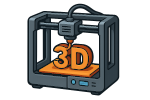
3d Printers
3D printers are one of the most exciting and versatile tools in a maker space. They allow you to turn digital 3D models into physical objects, and they’ve become increasingly affordable and user-friendly.
FDM (Fused Deposition Modeling) – Most Common
How it works: Melts and extrudes plastic filament layer by layer.
Materials: PLA, ABS, PETG, TPU (flexible), etc.
Great for: Prototypes, tools, models, functional parts.
SLA (Stereolithography) / Resin Printing
How it works: Uses UV light to cure liquid resin layer by layer.
Materials: Photopolymer resin.
Great for: High-detail models, miniatures, jewelry, dental/medical models.
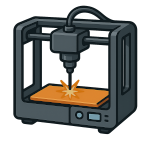
Laser Cutters
Laser cutters are powerful and precise tools in maker spaces—perfect for cutting, engraving, and etching a wide range of materials.
A laser cutter uses a high-powered laser beam to cut through or engrave materials with extreme accuracy. It follows a digital vector design (usually made in programs like Adobe Illustrator, Inkscape, or CorelDRAW).
CO₂ Laser Cutters – Most Common in Maker Spaces
Materials: Wood, acrylic, leather, cardboard, paper, rubber, fabric, some plastics
Not for: Metals (unless coated or very thin)
Power: Typically 30W to 150W
Diode Laser Cutters/Engravers
Budget-friendly: Usually lower power
Good for: Engraving wood and softer materials
Limitations: Less common for deep cuts or fast work
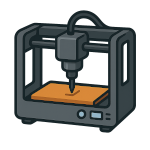
CNC Machine
CNC machines (Computer Numerical Control) are the heavy-duty, precision powerhouses of many maker spaces.
They let you take digital designs and carve, cut, drill, or mill materials into physical parts with incredible accuracy.
A CNC machine is a computer-controlled tool that moves along multiple axes (usually X, Y, and Z) to perform precise cutting or shaping tasks on materials like wood, plastic, foam, aluminum, and more.
CNC Router – Maker Space Favorite
Materials:Plywood, MDF, acrylic, HDPE, aluminum
Not for: Metals (unless coated or very thin)
Use it for:Signs, furniture, instrument bodies, circuit board milling, 3D relief carving